




Creativity is a defining feature of human cognition and a driving force for societal progress and individual achievement. Unsurprisingly, artists, philosophers, and scientists have always been fascinated by this uniquely human trait and have long attempted to both characterize and enhance it. Yet, although critical to human experience, creativity eludes study because creative thought is internally generated and not directly observable. A key question is whether creative output arises from spontaneous inspiration or from careful contemplation. As humans, we spend much of our time engaged in externally focused, cognitively demanding activities; yet it is nearly cliché that many creative breakthroughs occur during moments of introspection or idle mind-wandering. Isolated from the external world, mind-wandering allows the mind, at rest, to traverse the cognitive landscape; however, useful creative output requires reengagement with the external world to evaluate and contextualize creative ideas. Recent advances in cognitive neuroscience using invasive brain recordings suggest that creativity emerges from dynamic interactions among large-scale brain networks that balance spontaneous, internally generated thought with goal-directed judgment and appraisal.
In 1872, Friedrich Nietzsche argued in The Birth of Tragedy¹ that creative expression emerges from two opposing but complementary intellectual forces: spontaneous, chaotic Dionysian inspiration and rational, structured Apollonian logic. Creative output, in this view, requires a balance between imagination and discipline. Nietzsche later emphasized that creativity is not merely a product of unrestrained improvisation but rather depends critically on judgment and the capacity to reject, refine, and organize ideas into a coherent form.
This analysis foreshadowed modern theories of creative ideation that describe two cognitive modes—idea generation and evaluation. In idea “generation,” unconstrained thinking allows ideas to arise spontaneously. Thus, idea generation links creativity to more general forms of spontaneous thought, like mind-wandering—after all, useful novel ideas are less likely to arise if the mind is entirely focused on a specific task. Meanwhile, during idea evaluation, top-down constraints are imposed to assess candidate ideas and choose an optimal solution. Both phases are vital to successful creative output.
Rather than being a unidirectional transition from generation to evaluation, creative thought involves fluid bidirectional shifts between these modes of thought. This fluidity allows the thinker to “step back” from good—but possibly suboptimal—solutions and explore other options to find the best answer. Without this bidirectional process, the mind would “get stuck” with one solution and be unable to come up with alternatives.
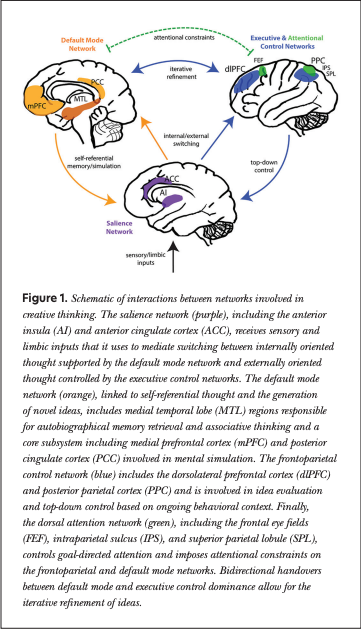
Creative idea generation, evaluation, and the transition between the two modes appear to rely on neural dynamics within and across distributed brain systems: the default mode network, which supports internally generated thought and memory-based simulation; the salience network, which detects behaviorally relevant information and helps regulate transitions between cognitive states; and executive control networks, which implement goal directed evaluation and attentional constraints (Figure 1). Here, we discuss these neuroanatomical and functional substrates that underlie creative thought.
The default mode network plays a complex role in the generation of creative ideas
Creative idea generation is thought to depend on the default mode network—so called because it comprises a set of brain regions that are often observed to be active at rest (i.e., the default mode of the brain) but deactivated during attention to external tasks. This network is also involved in self-directed thought processes like dreaming, mind-wandering, and episodic memory retrieval. Research has demonstrated that neural dynamics within the default mode network are shaped by the ongoing cognitive state and that creative thought corresponds to its recruitment.² Invasive manipulations in neurosurgical patients have also demonstrated a causal role of the default mode network in creativity: disrupting the integrity of this network through electrical stimulation decreases behavioral metrics associated with creative output.³
Although this network is consistently implicated in creative cognition, its contribution appears to be context-dependent and is not well described by simple increases or decreases in activity. Some studies have identified increased default mode network recruitment and interconnectivity during spontaneous thought and idea generation, but other studies have linked reduced coherence to enhanced associative thinking. For example, mindfulness meditation and psychedelics decrease connectivity within the default mode network and are thought to increase cognitive flexibility and divergent thinking.4,5 Some theories posit that reduced within-network synchrony in the default mode network—along with increased global
multimodal connectivity—may reflect a loosening of constraints that enables freer associative thinking.
The seemingly contradictory findings regarding the role of the default mode network in creativity may be reconciled by recognizing functional specialization within this network, including dissociations between known subsystems of the default mode network: a medial temporal lobe subsystem supporting associative thinking and a midline core centered on the medial prefrontal and posterior cingulate cortices that interfaces more closely with executive control regions. Creative performance may therefore depend not on global engagement of the default mode network but on flexible coupling between its subsystems and other networks, allowing spontaneous associations to remain accessible to evaluation and refinement.
The salience and executive control networks complement the default mode network to mediate transitions between idea generation and evaluation
Whereas default mode network activity is particularly associated with generating ideas via memory retrieval and mental simulation, the evaluation of the ideas requires coordination with the salience and executive control networks.6 The salience network, including the anterior cingulate cortex and anterior insula, is thought to play a role in switching between internally and externally oriented cognitive states and to mediate interactions between the default mode and executive control networks.7 During creative ideation, the salience network filters spontaneous thoughts, identifies promising ideas, and modulates their access to executive control systems, such that only relevant ideas are selected for elaboration and refinement. The executive control system, comprising frontoparietal and dorsal attention networks, can then evaluate candidate ideas for their novelty and utility given the ongoing behavioral context, attentional demands, and task-dependent constraints.8
The handover of control between default, salience, and executive networks is not a unidirectional sequence. Rather, top-down feedback from the executive control networks to the default mode network enables iterative refinement and the strategic exploration of alternative solutions when initial ideas prove suboptimal. By maintaining ongoing task-specific goals and directing attention, the executive control networks constrain the scope of further idea generation, improving the efficiency of creative thought production. Thus, rather than operating sequentially, the default mode, salience, and executive control networks exhibit dynamic interactions that enable the generation, refinement, and selection of creative ideas.
These network-based models of creativity are also directly relevant to neurosurgery. Operations for tumors, epilepsy, or other focal lesions may spare classical language and motor cortices yet still disrupt creative thinking if they injure critical hubs or white-matter connections within the default mode, salience, or executive control networks. A network-aware surgical framework could therefore improve preoperative counseling and intraoperative mapping and motivate postoperative assessment of higher-order cognition beyond standard neurological endpoints.
Creativity and mental health
Besides underlying a key human cognitive function, these network interactions are relevant to psychiatric disorders associated with altered creative thinking or dysregulation in related cortical networks. In a healthy brain, we observe anticorrelation between activity in the default mode network and externally directed attention; this anticorrelation is reduced in attention-deficit/hyperactivity disorder, which may explain both the attention disturbances and heightened divergent thinking that characterize this disorder. Meanwhile, psychosis is linked to enhanced idea generation (by increasing the likelihood of mental associations between unconnected concepts) but impaired idea evaluation. On the other hand, disorders characterized by rigid thought patterns or maladaptive rumination, like obsessive– compulsive disorder and depression, may reflect impairments in flexible thought. These links between creative ideation and mental health crystallize the importance of studying this cognitive ability.
Conclusion
Over the past several decades, cognitive neuroscience has moved away from strictly localizationist approaches toward network-based models of brain function that emphasize the role of distributed but interconnected cortical systems. This shift has been critical for the study of creativity, a multifaceted cognitive capacity that depends on flexible coordination within and across multiple large-scale brain networks. Understanding how these networks interact provides a mechanistic framework linking creativity with neural dynamics and deepens our appreciation of neuropsychiatric disorders caused by disruptions of these systems.
References
- Nietzsche F. Die Geburt der Tragödie aus dem Geiste der Musik [The Birth of Tragedy Out of the Spirit of Music]. Leipzig: E.W. Fritzsch; 1872.
- Rabinovich R, Cowan RL, Libowitz M, et al. Human brain network control of creativity. bioRxiv. 2025:2025.2006.2003.657648.
- Bartoli E, Devara E, Dang HQ, et al. Default mode network electrophysiological dynamics and causal role in creative thinking. Brain. 2024;147(10):3409-3425.
- Berkovich-Ohana A, Glicksohn J, Ben-Soussan TD, Goldstein A. Creativity is enhanced by long-term mindfulness training and is negatively correlated with trait default-mode-related low-gamma inter-hemispheric connectivity. Mindfulness. 2017;8(3):717-727
- Girn M, Mills C, Roseman L, Carhart-Harris RL, Christoff K. Updating the dynamic framework of thought: creativity and psychedelics. NeuroImage. 2020;213:116726.
- Beaty RE, Benedek M, Silvia PJ, Schacter DL. Creative cognition and brain network dynamics. Trends Cogn Sci. 2016;20(2):87-95.
- Menon V, Uddin LQ. Saliency, switching, attention and control: a network model of insula function. Brain Struct Funct. 2010;214(5-6):655-667.
- Gratton C, Sun H, Petersen SE. Control networks and hubs. Psychophysiology. 2018;55(3).