

Neurosurgeons are privy to nearly the entire spectrum of human emotion, certainly elation and profound grief, and often in swings that are only separated by the glass walls between patient rooms as we move from one to the next in the intensive care units, emergency departments, and postoperative family discussion rooms we visit as part of our workday. Back and forth. On and on. This very pattern, this metronomic rhythm, we learn early on as residents. A busy neurosurgical resident may be explaining to a grieving adult son that his beloved father will not survive his ground-level fall due to a massive subdural hematoma resulting in fixed and dilated pupils; that no surgery would reverse brain death. In that conversation there is world-altering sadness and often confusion (and sometimes anger) that the resident must learn how to manage in the moment, hopefully mirroring sage mentors from past experiences. Then, an emergent call comes from the pediatric ICU. There is a six-year-old child with acute hydrocephalus from a posterior fossa tumor who is herniating. Within minutes that same resident is donning her sterile gown while quickly explaining the upcoming external ventricular drain to the frightened parents, their world equally breaking apart in front of their eyes. Then, with a quick incision, a twist drill hole, and the passing of the ventricular catheter, the pressure is relieved. Soon afterwards, the child opens their eyes and the family is overcome with relief. Yet their journey is far from over.
We learn early on how to walk with our patients through these life-changing moments in which the very words that come out of our mouths and the actions that we both prescribe and proscribe, will live with these patients and their families forever. As we ourselves move through this life, our own families will at some point experience illness and suffering and those same extremes of sadness and joy. Then, inevitably, we will personally as well. And we will look to someone, hopefully well versed in walking with their patients for a time, to guide us to a place of understanding, acceptance, and hopefully healing. Life, death, joy, grief, anger, gratitude, pain, relief—these emotions and qualities all bind us together as human beings and we as neurosurgeons have the privilege to live these experiences with our patients and their families, and to try to heal as best as we can.
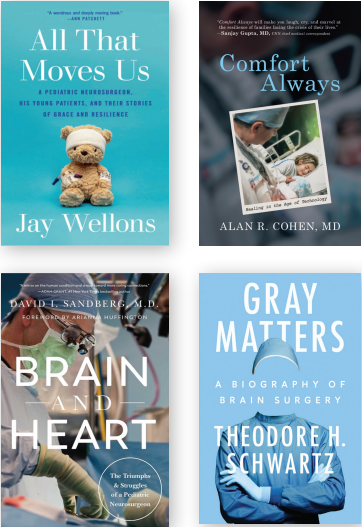
There is a strong history of physician writers over the course of recorded human history, chronicling not only symptoms and early understanding of disease, but the ethical and emotional aspects of medicine. Galen, Maimonides, John Keats, Anton Chekhov, William Carlos Williams, and the inimitable Oliver Sachs are just a few who have understood the importance of weaving a narrative through both fiction and nonfiction to expose a deeper understanding of the human condition. There have also been neurosurgeon writers as far back as Wilder Penfield himself, and more recently Paul Kalanithi whose moving memoir When Breath Becomes Air was published posthumously, and of course our field’s master storyteller Henry Marsh. Now there are, fortunately, an increasingly greater number of us who endeavor to uncover those same common threads that bind us all together.
I believe that neurosurgeons write because we want to tell our patients’ stories in a way that helps others see the courage in the midst of suffering, the hope both lived and dashed, because from that we all can gain just a bit more of an understanding of this life that we were put on this earth to live. In some way, our patients’ stories are ours too, just the tiniest bit, and just perhaps it is our responsibility to explain what it means for us to walk alongside them, tell of their lived experiences, and then reflect based on our own. Our perspective is indeed important. The neurosurgical memoirs
published to date are certainly not devoid of our own experiences. It was best-selling author Ann Patchett who once told me that readers need to understand the lens through which the writer witnesses their patients’ lives (or their characters’ lives if fictional), so that they in turn can better connect to the writer as well as the subject. I also believe that speaking of our perspective—our lens—better bears witness to our own metamorphosis as humans.
This work also helps to build a commonality. Important of course among our neurosurgical colleagues—I thought I was the only one struggling with this—but also in our readers. To tell these stories that we all deal with, of suffering and challenges and joy and self-doubt and all the places existing somewhere in between, brings a sense of knowing and understanding that begins to build the incredibly important sense of compassion for one another. Compassion that can be missing from the daily newsfeeds, or e-blasts, or podcasts from which money is to be made and power is to be gained by splitting us apart.
We write for all these reasons and so much more. The leadership of the Congress of Neurologic al Surgeons has found it fit to ask several of us neurosurgeon-writers to discuss the importance of the neurosurgical voice in literature as well as the nuts and bolts of the process of publishing at the upcoming CNS meeting in Washington, DC, in a lunchtime session entitled “Scalpel to Pen: The Neurosurgeon’s Guide to Getting Published.” Please join us where we will discuss our own motivations to write, as well as strategies to find an editor, agent, and publisher. Also on the docket for discussion: What does it mean to market a book, to go on book tour, and to try to communicate your message on a broader stage, even translating it to the screen? The members of the panel and I look forward to seeing you in Washington, DC.