



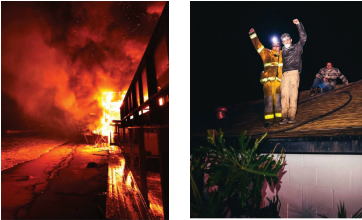
Thinking back to January 2025, the fire seems like a distant memory. However, many are still reeling from its effects nearly a year later. Having grown up in Los Angeles, wildfires are a common occurrence with our fire season ironically not occurring during summer, but rather in the dry months of late fall. We are blessed with the semi-arid climate of Southern California with periods of rain. The lush vegetation from these rains results in fuel for impending fires after scorching hot summers. Just a couple of weeks earlier, the Franklin Fire in Malibu burned a number of acres near Pepperdine University. That was quickly extinguished by our courageous Los Angeles and California Fire Departments. We thought that was it for the season….
However, in January, the forecast was ominous. With the Santa Ana winds forecast at unprecedented levels of 60-80 mph—reaching 100 mph in the coastal areas—high-risk fire advisories had been announced. Hence, it was not surprising to hear about the fire in the Palisades that Tuesday evening. It seemed like another typical fire that one would expect in such a dry and windy climate. Alas, we were sorely mistaken. Later thought to have been reignited from a prior fire in the same region, the Palisades Fire quickly consumed the dry vegetation in the Santa Monica mountains, just above the
Pacific Palisades community. Despite a swift response by the fire departments and first responders, nightfall interfered and due to high winds, fixed-wing and helicopter water and flame retardant resources were grounded. The fire grew exponentially. By the morning, the fire had grown to thousands of acres ultimately scorching 23,448 acres and destroying 6,837 homes and buildings. The amazing dedication and expertise of the first responders evacuated 105,000 citizens in the first hours of the disaster with only 12 ultimate fatalities. A truly heroic effort.
Nevertheless, many of us returned to work and quickly completed our scheduled operations. But by the afternoon, it was clear that this fire was going to define the next few days differently. The hospitals in the region including Santa Monica UCLA hospital and St. John’s Health Center of Providence St. Joseph’s Health—where I work—quickly canceled any remaining elective cases and effectively remained on alert in a triage state expecting to treat burn victims or other fire related casualties.
Many of us were caught up with the fire directly. In this period of confusion, where information was conflicting and people were being prohibited from returning to their homes, we had little sense if any of our friends’ or colleagues’ health or if their homes had survived. One colleague of mine returned to his home the morning after the fires started on the edge of the fire boundary to assess damage and retrieve a car. Initially, all seemed fine but within a few hours the hillside below his house erupted in flames engulfing trees and brush with strong winds pushing the flames and embers onto his house and multiple adjacent homes. He quickly summoned support from a team of firefighters on an adjacent street, and they created a camp at his house and were able to save multiple homes in that part of the Palisades.
The wildfire broke all rules and marched up the coast, destroying 780 beachfront homes. On that fateful day, after completing two endonasal skull-base operations with Dr. Daniel Kelly, Dr. Chester Griffiths returned to his home, driving through the fire to join his neighbor who was left alone and found that there were no fire resources in the region and the fire was completely encircling their homes. However, Chester had been through numerous fires in his time living in Malibu and had completed Community Emergency Response Team (CERT) training and acquired firefighting equipment with repetitive simulation trainings with his neighbor and college-age son. With the CAL Fire resources spread thin and his neighborhood in jeopardy, they quickly got to work.
As they had trained, they connected multiple fire hoses to the nearby fire hydrants, applied “Barricade Fire Retardant”, set up all emergency equipment and followed strict communicationengagement protocols and exit strategies. This effort resulted in saving his house, five neighbors’ homes, and a commercial building over the following five days—fighting the flames, inhaling smoke and communicating with fire command as part of a larger team. That saved neighborhood is now called the “Malibu Island.” Unfortunately, many were not as fortunate to be prepared or be available to protect their homes.
It did not help that during this challenging time of two major fires in Los Angeles County, the Palisades fire and the Eaton fire near the Jet Propulsion Laboratories (JPL), that at least four other fires were lit by arsonists, each burning hundreds of acres and drawing fire department resources away from fighting these larger fires. To add insult to injury, looters took advantage of the situation, vandalizing and stealing from the abandoned homes due to evacuation orders. On day three of the firefight, Dr Griffiths, his neighbor and son encountered a group of three masked looters in a van. They dissuaded them with appropriate threats to leave the street. This and similar looting events prompted the National Guard to arrive and to help restore security to the areas at risk.
I distinctly remember driving home and seeing numerous looters in our neighborhood, running through the trees and at least two individuals with gas cans throwing them into the shrubs in our community, one of which started a fire again requiring fire resources to extinguish. In a sense of irony, we needed to rely on the national guard and the local police to have continual presence in our communities to protect them from arsonists and looters. I never would have thought that I would relish having a soldier in fatigues, armed with automatic weapons in front of my community. However, it was a welcome sight to see these volunteers there keeping us safe for the following few months.
Today, the aftermath of the fires persists. Nearly half of all the properties in Pacific Palisades, Malibu, Altadena and Pasadena were lost (16,235 structures destroyed). Many have permanently relocated outside the state. To date, many evacuees still have not returned to their surviving properties due to safety or structural concerns. These fires exposed our fragile insurance system, overwhelmed by such massive catastrophes. The long-term ramifications will certainly affect the remaining population, property values and the possibilities of rebuilding in the area. Between all the fires in the area, 32 people had perished, with potentially over 400 others from fire-related health issues. An estimated $100 billion of property was lost or
damaged. Thousands of families have been displaced. Of the 50% of the population that had to evacuate, it is thought that only 1/3 to half will actually return to their homes to rebuild.
Throughout all the pandemonium however, some good has come as well. Our communities bonded to protect our property and our loved ones. I was taking on-call patrol shifts, reminding me of my residency days. Work never stopped beyond the first two days and we continue to come in and take care of those that were displaced or affected by the fires. People were able to look past their differences whether political, ideological or otherwise and the city residents bonded in solidarity against both natural and domestic challenges.
There are lessons to be learned from the aftermath of this fire. Much like in our M&M sessions, the fire department continues to learn key lessons including resource management, high-risk fire conditions, command structures, and financial support. A number of homes did survive in areas that were otherwise decimated, pointing to key architectural differences. That will certainly lead to structural codes that will be applied to new structures during reconstruction. “Watch Duty” has become a necessary app on our smart phones, alerting us to any new fires or other challenges earlier than one would expect. Dr. Griffiths suggests we all should apply the “Emergency Preparedness Culture” we practice in our professional lives to our personal community-neighborhood lives by engaging our community with CERT training, knowing who our neighbors are and their vulnerabilities, obtaining appropriate equipment and supplies, training, simulating and teaching each other as we do professionally. It is not “if” a disaster will occur, it is “when.”
Certainly, the fires were a life-altering event for many Angelenos. One would hope this would be a generational event, though these massive wildfires are happening at an increasing frequency. We have learned to always be prepared, to learn to rely on our neighbors and our loved ones. I have yet to meet a physician who plans to leave Los Angeles due to these fires. That is the epitome of grit and resilience among our healthcare professionals to lead emergency preparedness at “Home.”