




Congress Quarterly
Vignettes from the CNS Archives: Contributions of the Congress of Neurological Surgeons to Socioeconomic Issues

Issam Awad, MD, MSc, FACS, MA (hon)
CNS Historian and Archivist, 51st Past President

The contributions of the Congress of Neurological Surgeons (CNS) to socioeconomic issues are not widely recognized, yet they were an integral concern of the CNS founders and its first leaders. Documents in the CNS Archives, painstakingly assembled by its third Historian and first and leading Archivist, John Morgan Thompson (Past-President, 1970), chronicle the contributions of the CNS through its educational debates and committees to neurosurgical reimbursement, utilization and manpower needs, and professional liability.
This activism on behalf of our specialty led to the subsequent coalescence with the American Association of Neurological Surgeons (AANS) into what would later become the Joint Officers structure, the Joint Socio-Economic Committee, the Washington Office for Neurosurgery, and the Joint Council of State Neurosurgical Societies (JCSNS).
The earliest focus of CNS activities mostly involved establishing the credibility and special vision of the new organization. The first meetings strived for rigorous scientific content presented by the world’s leading experts, and increasingly lore-filled social activities and post-meeting travel excursions created fun-filled events of educational value to early attendees. Committee activities focused on membership development, incorporation, finances and bylaws of the fledgling new group.
Passionate correspondence among the Founders and CNS strategists, along with early Executive Committee minutes, articulated a populist and inclusive philosophy reflecting aspirations of young neurosurgeons rather than those of physicians who were already accomplished and established. These included exquisite plots of the prevalence of CNS members among practicing neurosurgeons, the rate of recruitment of those completing training, and the age distribution of CNS membership.
The third Annual CNS Meeting in New Orleans in 1953, presided over by Dr. Nathaniel Roger Hollister, included the roster of a Survey Committee, chaired by Dr. Averill Stowell, formalizing a democratic tradition of sounding the membership on issues of relevance to their professional life. This represented a departure from the tradition of elitism in that era’s more established professional societies.
In 1954, the CNS Meeting in New York presided over by Dr. James Rowland Gay included the first invited lecture on a socioeconomic topic at a CNS meeting. W. Scott Allen, Vice President of the Mutual Life Insurance Company of Boston, addressed the group on “Medico-legal Aspects of Compensation.”
The first Archives reference to the Socio-Economic committee (SEC) is recorded in CNS Executive Committee Meeting minutes of February 9, 1963, held in Chicago, Illinois, noting a presentation by Dr. William H. Mosberg Jr. about “a proposed questionnaire to be sent to the membership regarding the proposed national relative value scale of Blue Shield,” with the “desired goal of ascertaining the fee schedule of the numerous Blue Shield plans in existence in the United States, as well as determining the consensus of neurosurgical opinion on what would constitute a fair relative fee schedule.”
A motion by Dr. DeSaussure, seconded by Dr. Welford, authorized the SEC to continue to pursue the investigation. Later that year, CNS Executive Committee minutes from its summer meeting in Point Clear, Alabama on July 27, 1963, record that Dr. Mosberg was disappointed “with the response of Congress members to a request for information regarding fee schedule.”
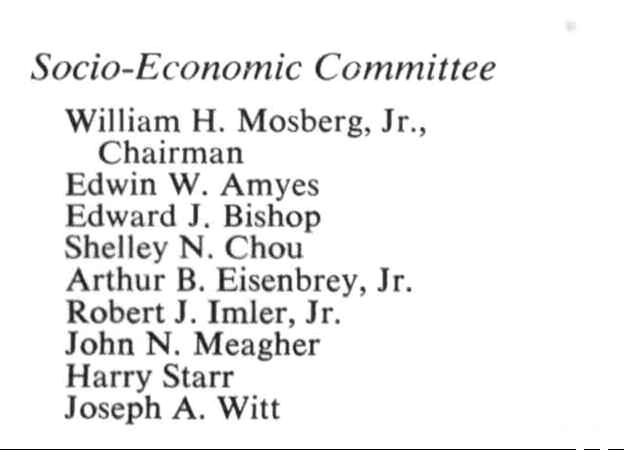
Nevertheless, Dr. Mosberg had apparently succeeded at compiling a list of neurosurgeons throughout the country serving on state fee schedule committees. The Executive Committee “directed Dr. Mosberg and his committee to proceed with its work on relative fee schedules.” The SEC Roster that year listed Drs. Edwin W. Amyes, Edward J. Bishop, Shelly N. Chou, Arthur B. Eisenbrey, Jr., Robert J. Imler, Jr., John N. Meagher, Harry Starr, and Joseph A. Witt, in addition to Dr. Mosberg as Chairman.
The Archives do not contain further documents on the subsequent status of Dr. Mosberg’s survey, although Dr. Robert Florin mentions that the actual survey was performed in 1964 and supplemented by additional surveys in 1965, with results sent to all CNS members. Fees for lumbar puncture ranged from $5 to $75, for herniated disc surgery from $250 to $1500, and for craniotomy for clipping of aneurysm from $275 to $2500.
The CNS SEC was chaired by Dr. Edward Bishop from 1964 through 1967, as Dr. Mosberg rose to the Presidency of the CNS. In 1967, the CNS Committees roster mentions Past-President Mosberg and President-Elect Dr. John R. Russell as “Representatives to Liaison Committee to the Harvey Cushing Society,” the first record of formal representation of CNS leadership in the AANS.
Subsequent CNS Presidents were often but not always listed as ex officio members of the AANS Board, including in formal presentation to the CNS of a summary of activities of the AANS Board.
Also in 1967, the CNS Committees roster includes a new “Ad Hoc Committee for Utilization Guidelines” chaired by Dr. William Lockhart, who led that committee from 1967 through 1969. The SEC was also chaired by Dr. Lockhart in 1968, and co-chaired by Dr. Lockhart and Dr. James T. Robertson in 1969.
The 1969 report by the SEC to the CNS Executive Committee “had to do entirely with the problem of malpractice.” The CNS Executive Committee entertained various schemes to facilitate insurance coverage of neurosurgeons.
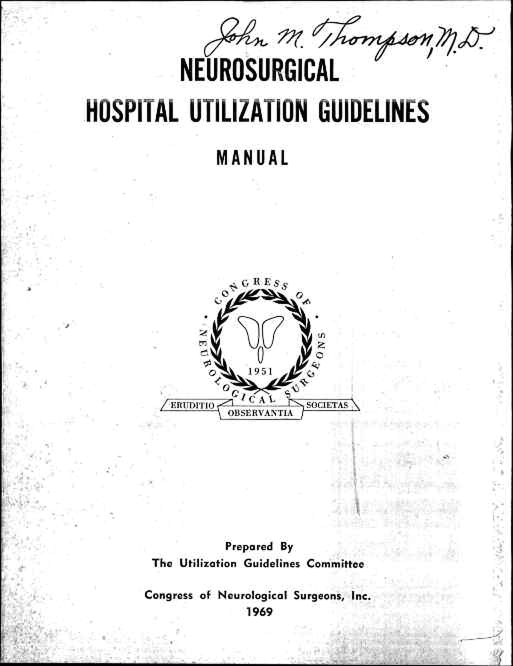
The year 1969 also witnessed the birth of a new CNS “Ad Hoc Committee on the Health Care Crisis” ensuring CNS representation along with that of other neuroscience professional organizations in a Washington-based professional coalition. Also in 1969, the CNS Utilization Guidelines Committee published a landmark manual on “Neurosurgical Hospital Utilization Guidelines.”
In 1970 and 1971, the CNS SEC was chaired by Dr. James Barnes. It is noted to have been authorized to reprint and mail the “Fee Survey” to CNS members.
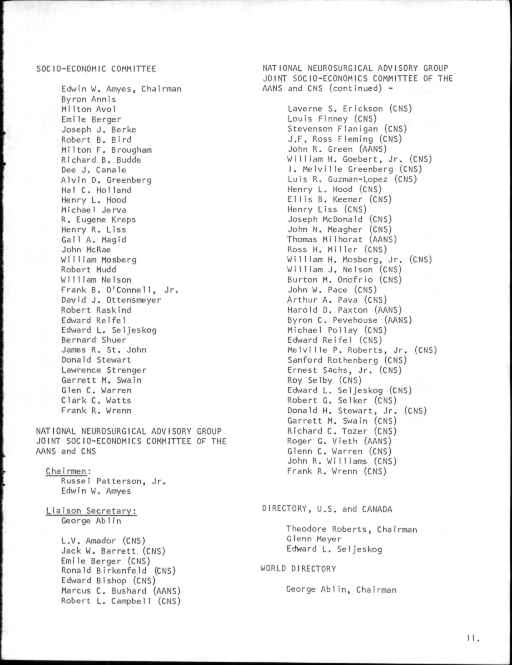
In 1972, the CNS SEC Committee chaired by Dr. Edwin Amyes joined the AANS to form the Joint Socio-Economic Committee of the AANS and CNS. This newly formed Joint-SEC launched a major subcommittee designated the National Neurosurgical Advisory Group (NNAG), including CNS and AANS appointed representatives from four regional quadrants of the United States.
The NNAG held its first meeting in Chicago on June 23, 1973, and its report was presented to the Joint-SEC, in conjunction with the CNS Meeting in Honolulu in October of that same year, and included recommendations for enhanced coordination with State Neurosurgical Societies.
In 1973, the roster of the CNS Committees lists the names of 33 members of CNS SEC Committee, the largest ever, chaired by Dr. Amyes. A separate listing includes those same members along with their AANS counterparts and regional appointees under the Joint-SEC-NNAG, with Dr. Russell Patterson, Jr. (AANS) and Dr. Amyes (CNS) as co-Chairmen.
Subsequent documents in the CNS Archives never again list the SEC as a separate CNS committee. The CNS Bylaws in use until that year, printed in 1960, 1964 and 1968 respectively, had not mentioned the SEC as a standing CNS Committee.
Despite the previously well-documented activities and incredible impact of that committee, and its listing in CNS committee rosters as far back as 1963, the CNS culture of volunteerism had essentially permitted this group to thrive for more than a decade as an ad hoc committee. The CNS Bylaws revised in 1978 finally articulated the charge and procedures of the SEC as one of the Joint Committees of the AANS and CNS.
The 1974 CNS Annual Meeting in Vancouver, British Columbia, presided over by Dr. George T. Tindall, organized an ambitious Symposium on Socioeconomics in Neurosurgery, including presentations by Drs. I. M. Greenberg on “Neurosurgery’s Constructive Response to the Changing Political Climate;” by F. Wrenn on the “Status of Neurosurgical Societies;” by D. Stewart on “Inter Relationship of Neurosurgery with Other Surgical Specialties in socioeconomics;” by G. Ablin on “Are there too many, too, few, or just the right number of Neurosurgeons;” by L. Finney on “the Case for Neurosurgeons as Amicus Curiae;” and by Dr. Amyes “Are Organizational Changes Needed in the structure of Neurosurgery?”
This was followed by a Symposium on Neurosurgery Manpower, with participation by Kemp Clark and that year’s Honored Guest, Guy Odom.
In follow-up to this intellectual debate, the 1975 CNS Meeting in Atlanta, presided over by J.T. Robertson, hosted a plenary General Scientific Session on Professional Liability, and an “Open Hearing” of the Joint-SEC on neurosurgical manpower on October 19, 1975.
The 1976 Report of the Neurosurgical Manpower Monitoring Committee of the AANS acknowledges that open hearing at the previous year’s CNS Meeting, along with discussions with many state neurosurgical societies, in formulating the 40 questions to American Neurosurgeons, representing the first recorded joint AANS/CNS national survey.
In 1976, a joint Committee of the AANS and CNS chaired by Dr. Louis Finnery established a liaison office in Washington, DC for the purpose of offering “guidance and advice concerning our relationship with various government agencies.” Charles A. Plante was designated as consultant at that office. This jointly funded venture has continued to serve our specialty on behalf of the AANS and CNS to this day.
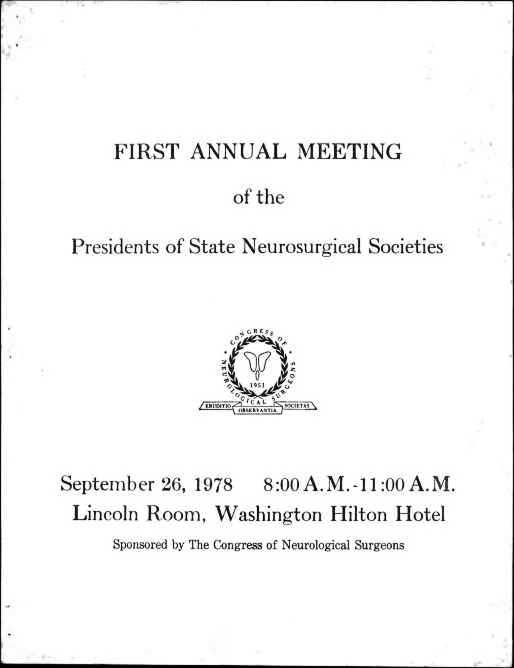
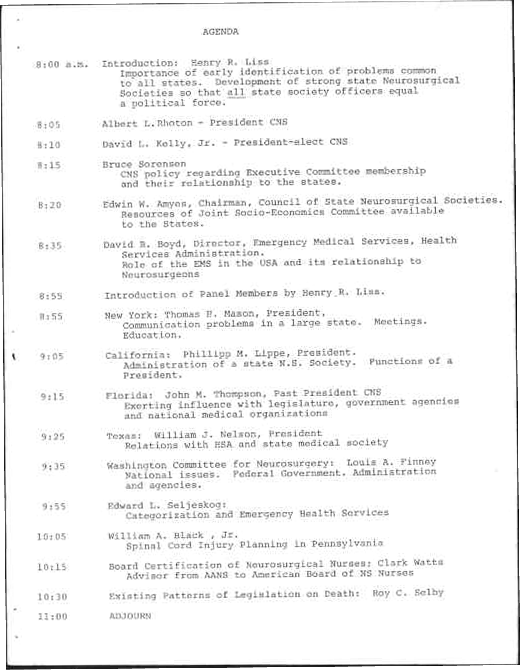
On September 26, 1978, the CNS sponsored the First Annual Meeting of the Presidents of State Neurosurgical Societies from 8:00 to 11:00 AM in the Lincoln Room at the Washington Hilton Hotel, in conjunction with that year’s CNS Meeting, presided over by Dr. Albert L. Rhoton, Jr.
That meeting’s agenda chronicles a number of initiatives, including a reference to the “Council of State Neurosurgical Societies,” the “Washington Committee for Neurosurgery,” and progressive discussions on “Categorization and Emergency Health Services,” and “Legislation on Death.”
In 1986, the CNS Newsletter included a report by Dr. Paul Croissant on the first meeting of the “Joint Council of State Neurosurgical Societies” (JCSNS) in Denver on Friday April 11, through Sunday April 13, 1986, and plans by the JCSNS for dedicated symposia in conjunction with that year’s Annual CNS Meeting in New Orleans the following October.
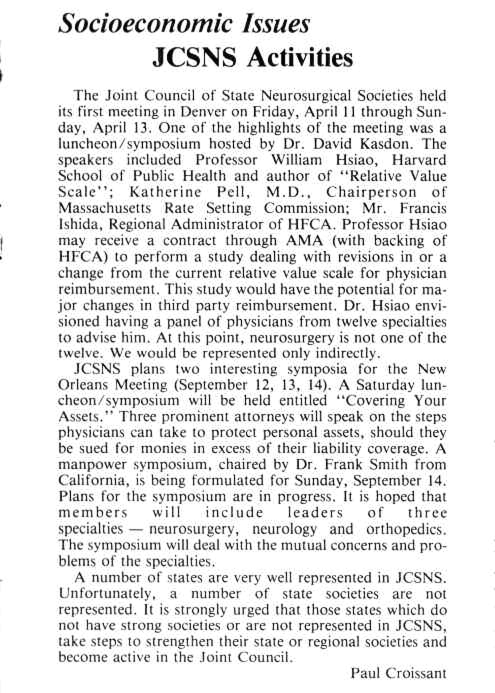
That was the beginning of a tradition of subsequent regular JCSNS meetings in conjunction with Annual Meetings of the AANS and CNS. The CNS has continued to marshall its leadership and volunteerism in the Washington Committee and Office, the JCSNS, and other socioeconomic forums since those pioneering days.
The author acknowledges enlightening discussions with Randy Smith, JCSNS Historian, regarding the NNAG and the early roots of the JCSNS.