






Climate crisis is a health crisis.
Already, climate change is directly contributing to the incidence of disease globally, accelerating infectious diseases, heat-related illnesses, non communicable diseases, adverse pregnancy outcomes, and malnutrition. The World Economic Forum estimates there will be an additional 14.5 million deaths by 2050 as a result of climate effects.1 These future risks are not abstract. Today, more than 84 percent of heatwaves to which people were exposed on average annually between 2020 and 2024 would not have been expected to occur without climate change.2
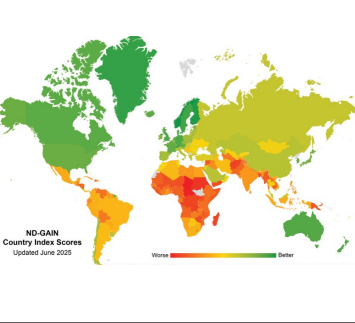
*Figure from the ND-GAIN project, showing the measures of a country’s vulnerability to climate change and its preparedness to adapt.5
Beyond these direct impacts, climate change indirectly fuels a vicious cycle of poor health by increasing poverty, threatening food security, and compromising sanitation. These burdens are felt most deeply by those already more vulnerable (Figure 1).
According to the World Bank, an additional 44 million people will be driven into poverty by 2030 from the health consequences of climate change. Migration will accelerate, in ways that increases the risk of disease transmission, disrupts access to health services and overwhelms health facilities already under resourced and overburdened.6 These risks are compounding existing diseases and epidemics including HIV, TB, malaria, growing burdens of noncommunicable disease, and preventable maternal deaths that still occur in pockets around the world.
These diseases cost in dollars as well as morbidity and mortality; the costs of growing disease burdens are mounting. The five leading causes of non-communicable disease burdens cost an average of
$2 trillion a year;7 annually, cardiovascular diseases alone cost the U.S. health care system $233.3 billion and cause up to $184.6 billion in lost productivity.8
As climate change accelerates all disease burdens, it also threatens to overwhelm our ability to respond. The COVID pandemic revealed important cracks in our health systems which remain vulnerable in the context of climate change. Over 90% of countries saw disruptions of health services as ill- prepared and under-resourced health systems splintered under the demand for services, the toll on health workers, the disruptions of supply chains, and the vaccine apartheid that left health workers and citizens in the world’s poorest countries at disproportionate risk.
These lessons, though, point to solutions. We need to build health systems that can deliver services and withstand shocks—whether COVID or the growing burdens from climate change. These resilient and responsive health systems are centered on prevention, surveillance, early intervention, and strong referral chains. They require moving from an approach of investing in disease silos to one that invests in the core building blocks of health systems with attention to mitigation of greenhouse gases, adapting to the changes we are already feeling and resilience to the shocks that climate change increasingly brings (Box 1).
Box 1: Core Definitions of Climate Response
Mitigation:
- Definition: Efforts to reduce or prevent the emission of greenhouse gases, the root cause of climate change.
- Goal: Limit damage from climate change
Adaptation:
- Definition: Adjusting to current or expected future climate impacts to minimize harm.
- Goal: Reduce vulnerability and cope with the unavoidable consequences of climate change
Resilience:
- Definition: The ability of individuals, communities, or ecosystems to withstand, adapt to, and recover from climate-related shocks and stresses
- Goal: Build the capacity to bounce back from climate-related disasters while adapting to changing conditions.
The World Health Organization (WHO) outlines the critical components of climate-resilient health systems. These include: climate-transformative leadership and governance; climate-smart health workforce; assessment of climate and health risks and GHG emissions; integrated risks monitoring, early warning, and GHG. emissions tracking; health and climate research; climate-resilient
and low-carbon infrastructures, technologies, and supply chain; management of environmental determinants of health; climateinformed health programs; climate-related emergency preparedness and management (Box 2).
Box 2: Operational Framework for Climate-Resilient Health Systems
Climate-transformative leadership and governance to integrate health and climate policy and promote cross-sector collaboration.
Climate-smart health workforce to identify, manage, and mitigate the health impacts of climate change.
Assessment of climate and health risks and greenhouse gas emissions to inform effective policies and mitigation measures for sectors with high GHG emissions.
Integrated risks monitoring, early warning, and greenhouse gas emissions tracking to strengthen early warning systems, improve infectious disease control and response time and inform a sustainable approach to energy use, procurement, and manufacturing.
Health and climate research to guide effective policies, innovative solutions, and combat misinformation and mistrust.
Climate-resilient and low carbon infrastructures and technologies to reduce healthcare’s significant impact on GHG as well as durable infrastructure and supply chains that can withstand climate risks.
Cross-sectoral management of environmental determinants of health
to implement effective preventative measures, jointly monitor environmental exposures and health outcomes, and define regulatory standards.
Climate-informed health programs to address climate-sensitive health risks, preparedness, and response to extreme weather events and crises.
Climate Related Emergency preparedness and management based on proactive planning, responsive systems, and community engagement.
Sustainable climate and health financing which recognizes that those most vulnerable to climate change often have the least financial flexibility for adaptation and mitigation measures and which is aligned with their national health plans.
Several pillars stand out
The first critical priority is mitigating the health sector’s significant contributions to climate change. The sector is responsible for 5% of all greenhouse gas emissions globally and 10% of all greenhouse gas emissions in the United States. While a significant contribution of the sector comes from pharmaceutical development and production, almost 50% of emissions arise from the patient care pathway. For example, while essential, surgical suites are three to six times more energy intensive than the rest of the hospital. Strategies to reduce this footprint include avoiding the use of
certain inhaled anesthetics, scaling renewable energy sources, optimizing reusable or non-disposable resources, reducing waste and recycling materials when possible. There are efficiencies to be gained without compromising patient care. Further, placing a primacy on prevention, early intervention and effective disease management is key to reducing the demand side of the equation.
The second priority is the need to ensure strong data management and surveillance of risks and outcomes. Systems must integrate climate data, health risks and air pollution and greenhouse gas monitoring, leveraging early warning systems for climate-sensitive diseases and emergencies. The WHO and World Meteorological Organization have a joint office for Climate and Health which spearheads a new Global Heat Health Information Network for example. Early detection and assessment of risks will help to prevent diseases, ensure early intervention and protection of supply chains, infrastructure and resources.
Third, too often overlooked and underfinanced, is advancing the size and capacity of the health workforce. Today there is a critical shortage of 11 million health workers, 6 million of whom are in subSaharan Africa where the impacts of climate change are being felt most acutely. Yet, health workers are the frontline of any health system response. Through our work at Seed Global Health (Seed), we have seen firsthand the power of this investment. Health workers are our greatest tool for protecting vulnerable populations from the increasing impacts of climate change and building sustainable health systems.
Our work in Uganda provides a case study. In partnership with the Government of Uganda, Seed has helped to build the country’s first national emergency medicine training program. In the country of 55 million, over half the deaths are from a failure of emergency and triage services. Climate change is making the risk of infectious diseases like Ebola Virus Disease (EVD) higher in Uganda and elsewhere as environmental disruptions caused by climate change, such as droughts and wildfires, push wildlife into human areas and increase the risk of disease outbreaks. In January 2025, Uganda declared an outbreak of the Sudan strain of EVD. There is no vaccine available for this strain leaving health workers as the main line of defense to educate, triage and care for patients. Through our partnership with the government, we helped train over 4,000 health workers in EVD protocols, supporting the health worker cadres that carried out surveillance and case identification, performed triage protocols, and ambulance decontamination. When the outbreak subsided, these same health workers applied their enhanced skills to routine emergencies, reducing trauma and stroke fatality by 8% and improving maternal emergency management enough to cut the institutional maternal mortality ratio by 25% in the facilities where we work.
Our response to the growing challenges at the nexus of climate and health is embedded in building resilient health systems that can help mitigate carbon emissions, withstand challenges to infrastructure and core resources and tackle the growing burdens of disease with quality and access. It will require enhanced understanding of the importance of health for stable communities, scaling of financing to increase health-centered investments, and leadership at every level to enhance prevention, reduce waste and optimize care.
In the end, climate change is not best measured in terms of degrees Celsius, but in lives lost or saved. Climate resilient and responsive health systems are the frontline of that metric.
Disclosure: Dr. Vanessa Kerry serves as the World Health Organization Special Envoy for Climate Change and Health (unpaid)
Funding: Seed Global Health receives funding from Abbott Fund, Anonymous (2), Bancel Philanthropies, Bank of America, The Charles Engelhard Foundation, Chest Foundation, CRI Foundation, Drue and HJ Heinz II Charitable Trusts, The ELMA Foundation, Equinox Foundation, Fundacion Faro Verde, Gates Foundation, Godley Family Foundation, International Organization for Migration (UN), IZUMI Foundation, Moderna Foundation, Pfizer, Risk Pool Fund, The Rockefeller Foundation, Schooner Foundation, Takeda Pharmaceuticals, Three Cairns Group, Wagner Foundation, The Wyss Medical Foundation, The Heinz Family Foundation.